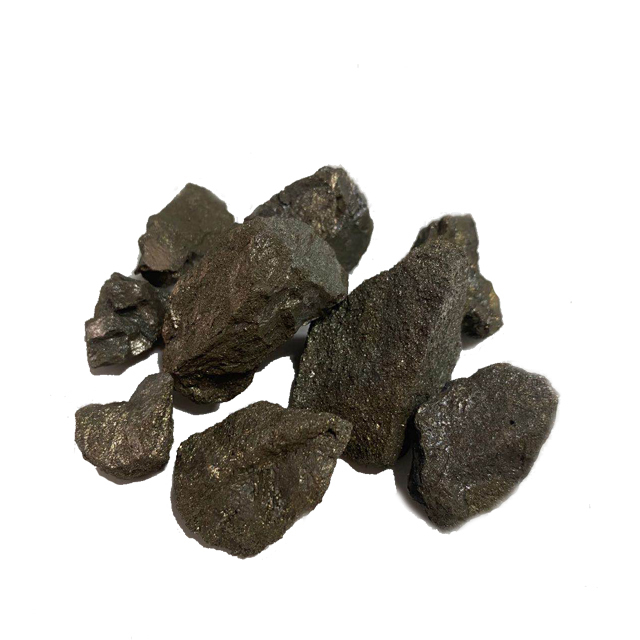
Ferro Boron
Ferro Boron
Ferro Boron
- Detail
- Parameters
Ferro Boron
Category | Grade | Chemical Composition(%) | |||||||||
B | AI | Si | C | S | P | Cu | Mn | ||||
Micro Carbon Ferro Boron | FeB20C0.05 | 19.5 | 0.5 | 1.0 | 0.05 | 0.01 | 0.05 | 0.05 | 0.35 | Magnetic material | |
Low Carbon Ferro Boron | 1# | FeB20C0.1 | 20 | 0.5 | 1.0 | 0.1 | 0.01 | 0.05 | 0.05 | 0.35 | |
2# | FeB19C0.1 | 19-20 | 0.5 | 1.0 | 0.1 | 0.01 | 0.05 | 0.05 | 0.35 | ||
3# | FeB18C0.1 | 18-19 | 0.5 | 1.0 | 0.1 | 0.01 | 0.05 | 0.05 | 0.35 | ||
Medium Carbon Ferro Boron | 1# | FeB20C0.5 | 19-20 | 0.5 | 1.0 | 0.5 | 0.01 | 0.1 | Steel casting | ||
2# | FeB18C0.5 | 17-19 | 0.5 | 1.0 | 0.5 | 0.01 | 0.1 | ||||
3# | FeB16C1.0 | 15-17 | 0.5 | 1.0 | 0.5 | 0.01 | 0.1 | ||||
4# | FeB14C1.0 | 12-15 | 0.5 | 1.0 | 0.5 | 0.01 | 0.1 | ||||
Low Aluminum Ferro Boron | 1# | FeB18AI0.05 | 17-18 | 0.05 | 1.0 | 0.5 | 0.01 | 0.05 | 0.05 | 0.35 | Non (micro)crystalline alloy |
2# | FeB17AI0.05 | 16-17 | 0.05 | 1.0 | 0.5 | 0.01 | 0.05 | 0.05 | 0.35 | ||
Basic Information
An alloy of boron and iron.
According to the carbon content, ferroboron (boron content: 5-25%) can be divided into low carbon (C≤0.05%~0.1%, 9%~25%B) and medium carbon (C≤2.5%, 4%~19 %B) Two kinds. Ferroboron is a strong deoxidizer and boron additive in steelmaking production. The biggest role of boron in steel is that it can significantly improve the hardenability and replace a large number of alloying elements with a very small amount. In addition, it can also improve mechanical properties, cold deformation properties, welding properties and high temperature properties.
Is mainly used in steel and cast iron. Used in alloy structural steel, spring steel, low-alloy high-strength steel, heat-resistant steel, stainless steel, etc. Boron can improve toughness and wear resistance in cast iron, and is widely used in the manufacture of automobiles, tractors, and machine tools.
Nature and application
The atomic weight of boron is 10.81. The electronic structure is 1s2s2p. The density of crystalline boron is 2.31 g/cm (20°C), and the density of amorphous boron is 2.30 g/cm (20°C). The melting point is 2079°C and the boiling point is 3660°C. The equilibrium phase diagram of the boron-iron binary system is shown in Figure 1. In the boron-iron system, there is a eutectic point at a boron content of about 3.8%, and its eutectic temperature is 1149°C. Iron and boron produce two kinds of intermediate compounds, Fe2B and FeB, which are also extremely stable at high temperatures. FeB has two crystal types: high temperature and low temperature. The melting temperature range of industrially produced ferroboron (10%-20%B) is 1400-1550℃, and the density is 5.8-6.5g/cm3.
A small amount of boron (0.001%) can double the hardenability of steel. Adding about 0.003% B to stainless steel can improve its workability. Boron has the property of absorbing neutrons, which can hinder or stop the chain reaction of uranium-graphite nuclear reaction. Therefore, steel with high boron content (>1%B) is used in the nuclear energy industry. Boron can affect graphitization in cast iron, thereby increasing the depth of white mouth. When the amount of boron is more than 0.01%, it has an obvious effect of stabilizing carbides, thus improving the wear resistance of cast iron. Cast iron rolls contain 0.02% to 0.1% boron, which can increase surface hardness and improve white solidification. The addition of boron in malleable cast iron up to 0.001% to 0.005% is beneficial to the formation of nodular graphite. At the same time, it can increase graphite particles and improve its distribution. This effect is conducive to annealing treatment.
Fe-based, cobalt-based, nickel-based metal powder for spraying (welding), containing 0.5% to 4.0% boron. Amorphous boron-containing iron-silicon-boron alloys, such as Fe92Si5B3, can replace oriented silicon steel to manufacture low-iron loss, small-volume energy-saving transformers and other devices. Nd2Fe14B, Nd15Fe77B8 and other neodymium iron boron permanent magnets have the advantages of high remanence, high coercivity and high energy product, and are ideal materials for manufacturing permanent magnet parts.